Private Market Valuations Are Under the Microscope
March 23, 2026
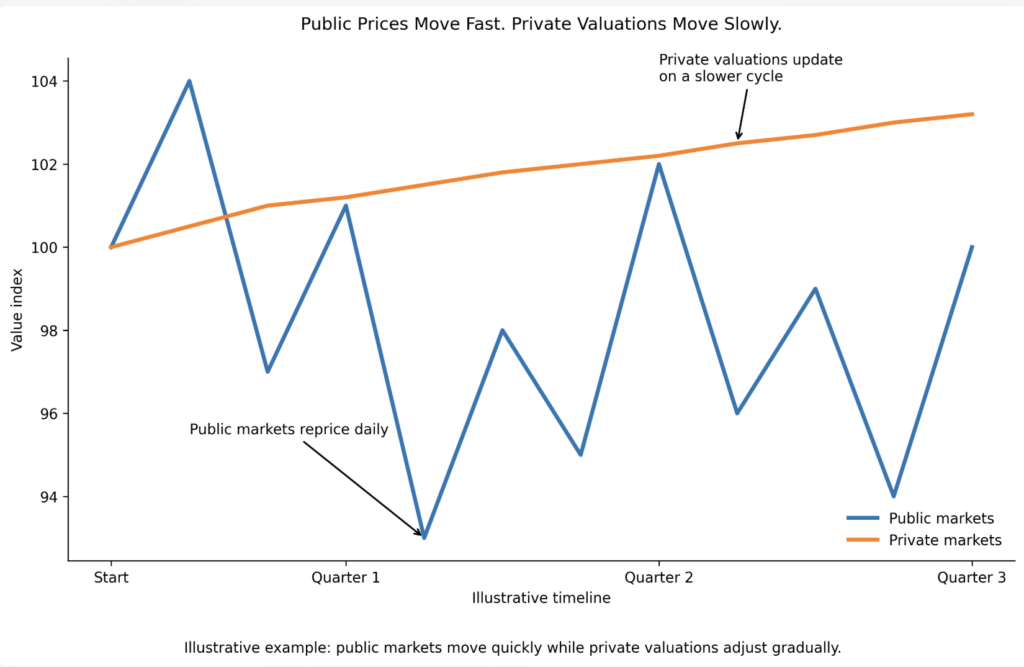
Private market valuations are under more pressure because investors are finally paying closer attention to how these numbers are produced.
Public markets have trained people to expect instant price discovery. A stock drops in real time. A bond widens in real time. The market reacts fast and everyone sees it at once. Private assets do not work that way. Their values are reviewed on a slower timetable through operating performance, comparable transactions, and internal models. That structure feels fine when markets are calm. It gets a lot more uncomfortable when volatility picks up and public prices start moving hard.
That discomfort is exactly what has been building.
Over the past year, public markets have absorbed every macro headline the second it hit. Rates moved. Sentiment turned. Risk repriced. Many private assets, meanwhile, continued to carry steadier marks. That has forced a bigger conversation into the open. Investors want to know whether private valuations are capturing present conditions or simply arriving there later.
The answer sits inside the mechanics of the asset class. Private investments are built for long holding periods. They are managed through operations. They are valued through a process that depends on judgment, documentation, and performance data rather than constant trading. That process can be rational and still leave investors wanting more clarity, especially when public markets are sending a very different message.
This is where the topic gets more serious. The issue is not whether private valuations should look exactly like public markets. They should not. The issue is whether investors have enough visibility into how those marks are being set and whether the assumptions behind them still hold up under pressure. That is where confidence gets won or lost.
Institutional investors understand this better than most. They know private assets are not screens. They know operational performance matters. They know value takes time to build. At the same time, they also know that stable valuations are only useful when the process behind them is strong enough to withstand scrutiny. A calm mark without real transparency can quickly start to feel fragile.
That is why price discovery matters so much right now. Secondary transactions are drawing more interest because they give the market something periodic reports cannot fully provide. They show where actual buyers and actual sellers are willing to meet. In a part of the market where values do not update daily, those transactions add badly needed texture and discipline.
Private market valuations are getting more attention because private markets are too large to operate on trust alone. More capital is involved. More investors are watching. More scrutiny is coming. That does not weaken the asset class. It forces it to grow up.
LPshares is a secondary marketplace for limited partner interests in private real estate and alternative assets.