When a Real Estate LP Position Still Performs but the Investor Needs a Different Path
March 26, 2026
Private real estate has always asked investors for patience. Capital goes in, the sponsor carries out the plan, and the return is expected to arrive over time. That structure can work well, especially when the asset is healthy and the original timeline still makes sense for everyone involved. The problem is that investor needs don’t always stay frozen while a deal runs its course.
So what happens when the asset is doing fine, distributions are coming in, and the investor still wants liquidity?
That question sits at the center of a growing part of the market. For years, private real estate has treated liquidity as something that arrives at the end of the story. An LP commits capital, waits through the hold period, and exits when the sponsor refinances, recapitalizes, or sells. That may sound straightforward in an underwriting deck, but real portfolios rarely move in such a clean line.
An investor may want to free up capital for a new opportunity. A family office may be simplifying older holdings. An estate may need liquidity on a very different timeline than the asset itself. None of that automatically points to a problem with the property. In many cases, the asset is still occupied and still producing income, while the sponsor continues to carry out the original plan. The change is often happening around the investment, not within it.
Why is that worth talking about now?
Because private real estate has long had a blind spot around this part of ownership. It has built a strong framework around acquisition, leasing, financing, and exit strategy, yet it has left very little room for the fact that investor circumstances can change midstream. Once capital is committed, the standard answer has often been to wait. Wait for a major event at the asset level. Wait for the business plan to finish. Wait until the market delivers a clean opening. That patience can be admirable, but it can also leave investors with very few practical options when their own timeline changes first.
That friction spreads across the entire ownership structure, since LPs often have few practical ways to pursue liquidity and sponsors are left handling those requests within a framework that offers limited flexibility. At the same time, buyers who would welcome access to seasoned positions may never see them because many of those opportunities stay inside private conversations instead of reaching a broader pool of qualified capital.
That is where the secondary market becomes more relevant.
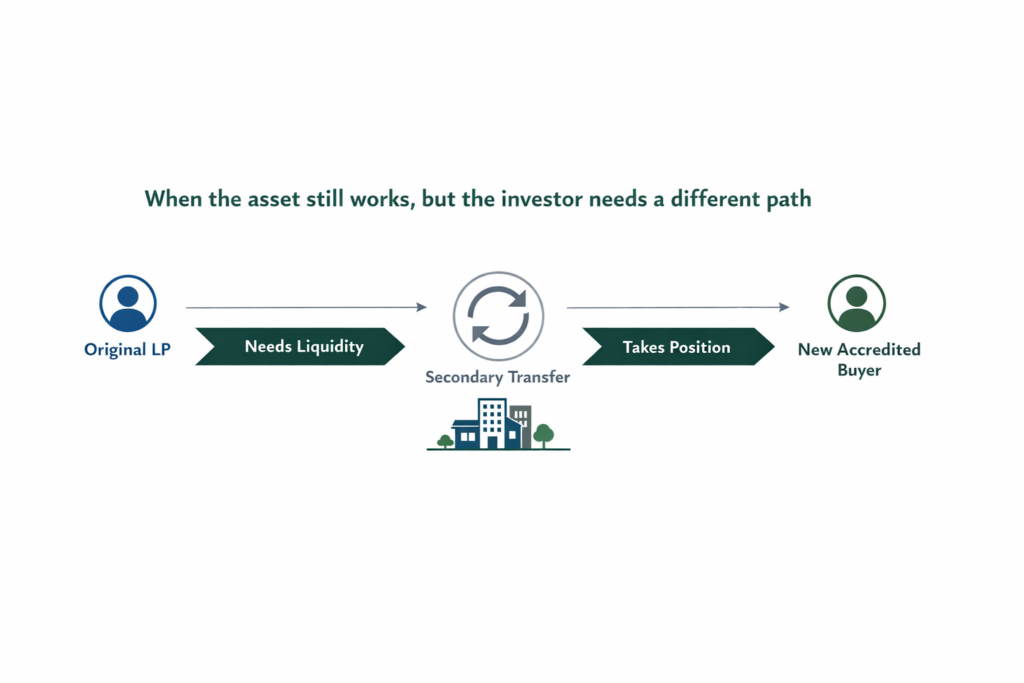
What is a secondary transaction in private real estate? At its core, it’s the transfer of an existing LP interest from one qualified investor to another before the underlying property is sold. The real estate stays in place. The sponsor stays in place. The business plan can stay in place. What changes is the investor holding the interest. That single change opens the door to something private real estate has historically struggled to offer: flexibility without forcing a full sale of the asset itself.
Why would a buyer care about stepping into an existing LP position instead of joining a new raise?
Because a seasoned position can offer a very different kind of entry point. Rather than buying into a story that is still being formed, the buyer may be able to review an operating asset with an established track record, actual cash flow, and a clearer picture of how the sponsor has been performing. The opportunity is already in motion. That does not erase risk, of course, but it can give buyers a level of visibility that feels very different from subscribing to a brand-new deal.
And why would a seller move on from a position that is still producing income?
A seller may decide to move on even when the asset is performing well, because the change is often happening in the investor’s world rather than inside the deal itself. They may need more liquidity, want to reduce exposure to one holding, or be working through estate planning and a broader portfolio cleanup. Private real estate has not always offered an easy way to respond to those changes, which is one reason secondary liquidity is drawing more attention.
Long-term investing works best when investors have room to respond as their needs change over time. A stronger market gives people more than one way to move forward, especially when ownership can change hands without disrupting the asset itself or creating extra strain for sponsors.
That’s also why sponsors have a reason to care. When there is no orderly route for an LP who wants out, the sponsor often becomes the one absorbing that tension. Those conversations can drag on, and they rarely help anyone when there is no structured process behind them. A more organized secondary channel gives sponsors a better way to support existing investors while keeping control over approvals, access, and the broader integrity of the deal.
So where does LPshares come in?
LPshares was built to help accredited investors, LPs, and sponsors connect around private market opportunities with more structure and more visibility. For sellers, that can mean a clearer path toward liquidity when an existing position no longer works for their portfolio. For buyers, it can mean access to discounted interests in deals that are already operating and already producing real information. For sponsors, it can mean a more practical way to help investors navigate ownership changes without losing control over who enters the deal and how the process is handled.
The broader takeaway is simple. Private real estate still works best when it is built for the long term, but that doesn’t mean every investor should be locked into the exact same timeline from day one through final exit. Capital needs can change well before a sale, and portfolio goals or family circumstances can change with them. When the market has no room for that, it becomes harder than it needs to be.
A good asset can still be a good asset when one investor is ready to move on and another sees value in stepping in. That’s part of what a more mature secondary market allows. It gives private real estate a way to make room for real life without asking the property itself to carry a problem it didn’t create.
LPshares is a secondary marketplace for limited partner interests in private real estate and alternative assets.