Why Secondaries Keep Getting Bigger in Private Markets
April 13, 2026
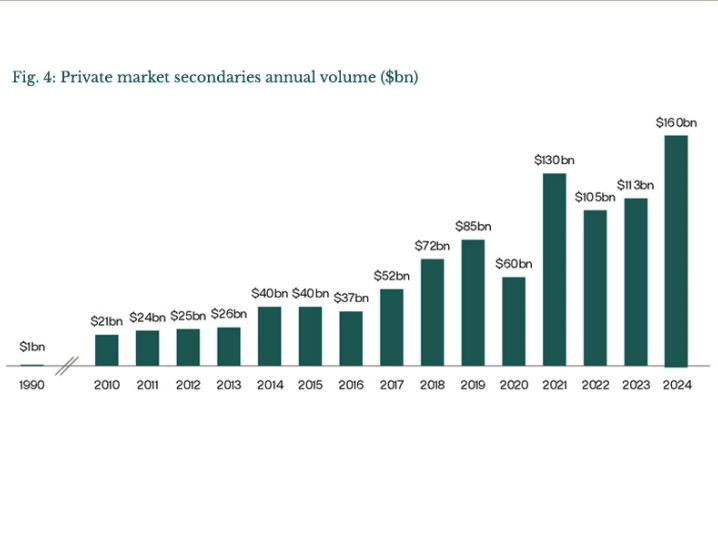
The secondary market is having a very serious year, and it’s getting harder to treat that as some niche corner of private capital. William Blair’s latest Secondary Market Report puts total 2025 volume at $220 billion, with activity split evenly across GP-led and LP-led deals, and projects that total could reach $250 billion in 2026. That kind of growth doesn’t happen because the market is bored and looking for something new to do. It happens because liquidity still needs a path, even when the original timeline is no longer cooperating.
So what is driving that growth?
William Blair points to two forces moving at the same time. On one side, GPs are under pressure to create liquidity because private equity portfolios are still carrying trillions in unrealized assets and hold periods have stretched out. On the other side, secondary buyers are not exactly short on capital. The report says secondary funds raised a record $95 billionin 2025, with $248 billion of dry powder sitting behind the strategy at the end of the year. When supply keeps building and capital is waiting to meet it, the market gets bigger very quickly.
Why should that get LPs’ attention?
Because the old private market assumption was always pretty simple: commit capital, stay patient, and wait for the exit. That still works when timing behaves. The problem is that timing has been behaving badly for a while. Midmarket M&A has stayed fairly static even as headline transaction value improved, IPO proceeds went up without a big jump in the number of offerings, and many portfolios are still dealing with limited liquidity and longer hold periods. Secondaries have kept growing right through that environment because they give investors and sponsors another route when the clean exit is taking too long to show up.
That’s also why this conversation feels bigger than classic private equity secondaries. William Blair notes that evergreen funds are approaching $700 billion in AUM and are expected to grow faster than the broader private markets over the next decade. Those structures are well suited to secondaries because the asset class has shorter duration, milder J-curve effects, and more predictable distributions. In plain English, more capital is being raised in vehicles that want flexibility, and secondaries are increasingly part of how that flexibility gets expressed.
What does that mean for LPshares?
It means the market is moving toward the exact problem LPshares was built to address. Large institutional buyers have had their own lanes for years, but many accredited investors and smaller holders have had far fewer clear options when timing changes before a full exit arrives. The need is not always distress. Sometimes an LP wants liquidity because capital is needed elsewhere. Sometimes a portfolio has gotten too crowded. Sometimes a good position no longer fits the person holding it. The broader market is finally putting real scale behind the idea that ownership doesn’t have to stay frozen for an asset or fund interest to keep doing its job.
The William Blair report also shows how normal this has become on the sponsor side. GP-led volume reached $110 billion in 2025, and single-asset continuation funds rose to $60 billion from $34 billion the year before. Sponsors are using these structures to provide liquidity, keep strong assets in the portfolio longer, and extend the runway for value creation. That tells you something important about where private markets are headed: liquidity is no longer being treated like a side conversation. It’s becoming part of the operating system.
And what should investors take from that?
They should take the hint that secondaries are no longer some specialist strategy living in the background while the rest of private markets get the spotlight. The market has grown because private capital needs better ways to deal with delayed exits, changing portfolio goals, and investors who want more control over timing. When secondaries hit new records during a period of stretched hold times and uneven exit conditions, that says something very clear. Liquidity is not a side issue anymore. It’s moving closer to the center of how private markets work.
At LPshares, that feels very familiar. We see a market that still wants long-term private exposure, but also wants a more realistic way to handle ownership when life moves faster than the original underwriting model. The firms and platforms that make that easier are going to keep getting more relevant, because private markets are asking for more flexibility now, and the secondary market is one of the clearest places where that demand is already turning into action.